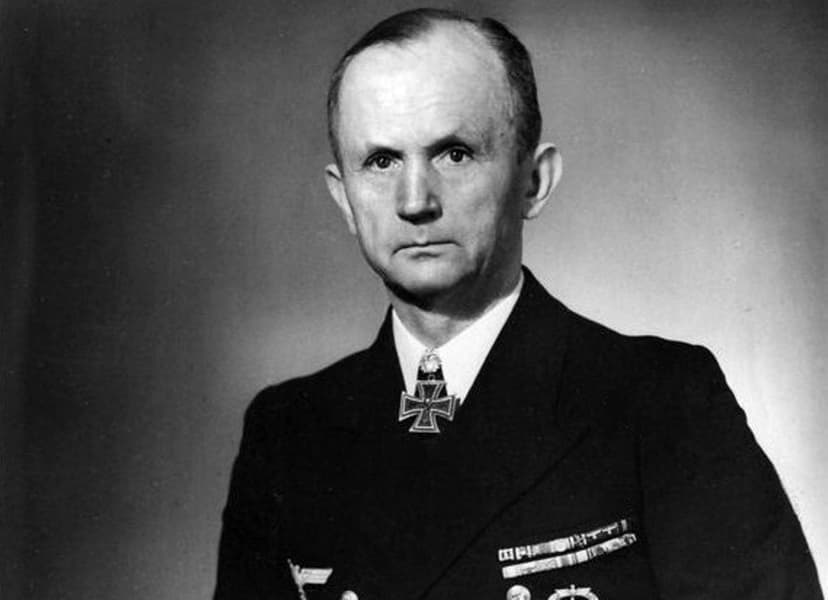
Karl Donitz
THE GRAND ADMIRAL
KARL DONITZ
Karl Dönitz (1891–1980) was a German naval officer who commanded Germany’s submarine force during much of World War II and later served as Commander-in-Chief of the Kriegsmarine. Following Adolf Hitler’s death in April 1945, Dönitz became President of Germany and led the short-lived Flensburg Government until its dissolution by the Allies. His role in the Battle of the Atlantic and his loyalty to the Nazi regime have made him one of the most controversial military figures of the twentieth century.
Early Career and Rise
Born in September 1891 near Berlin, Dönitz entered the Kaiserliche Marine in 1910. He initially served aboard surface ships before transferring to the submarine service during World War I. By 1918 he commanded U-boat UB-68 in the Mediterranean. After the submarine suffered mechanical problems and was forced to surface, Dönitz ordered it scuttled and was taken prisoner by British forces. He remained a prisoner of war until 1919. After the war, Dönitz continued his naval career in the Reichsmarine, one of the few military institutions permitted under the Treaty of Versailles. When Germany began rebuilding its submarine force following the Anglo-German Naval Agreement of 1935, Dönitz was placed in charge of the new U-boat arm. He became a strong advocate of submarine warfare and focused on developing tactics, training programs, and crew organization. He married Ingeborg Weber in 1916, and the couple had three children. During World War II, both of his sons were killed while serving in the German armed forces.
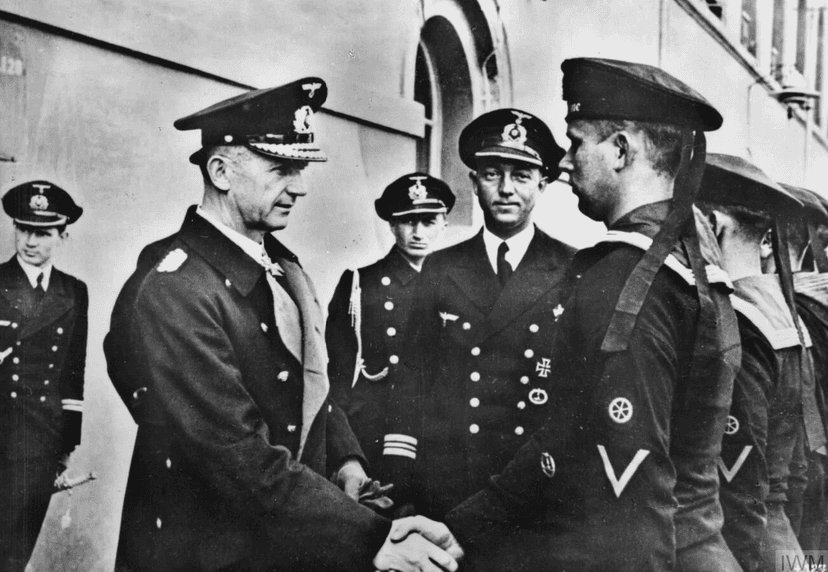
Karl Dönitz shaking hands with sailors
Commander of the U-boat Campaign
With the outbreak of World War II, Dönitz's submarines became a central element of Germany's naval strategy. He played a major role in developing the “wolfpack” tactic, in which groups of submarines coordinated attacks against Allied convoys. During the early years of the war, German U-boats inflicted heavy losses on Allied shipping and posed a serious threat to Britain's maritime supply routes. Throughout the conflict, German U-boats sank more than 3,000 Allied and neutral merchant vessels. However, by mid-1943 Allied improvements in convoy tactics, radar, air patrols, and codebreaking significantly reduced the effectiveness of the submarine campaign. In January 1943 Dönitz was promoted to Großadmiral and succeeded Erich Raeder as Commander-in-Chief of the Kriegsmarine. He continued to direct submarine operations until the end of the war despite Germany’s deteriorating strategic position.
Leadership Style and Nazi Loyalty
Unlike many prominent figures in Nazi Germany, Dönitz was primarily a career naval officer rather than a political leader. He emphasized discipline, professionalism, and obedience within the navy. Although he did not formally join the Nazi Party until 1944, he had long demonstrated loyalty to Adolf Hitler and publicly supported the regime. Dönitz encouraged ideological instruction within the navy and frequently praised Hitler’s leadership in speeches and official communications. The Kriegsmarine was less involved in the July 20, 1944 plot against Hitler than the German Army, which further strengthened Hitler’s confidence in Dönitz. As Germany's military situation worsened, Dönitz continued to advocate resistance and committed naval personnel to ground combat operations in the final months of the war. One of the most controversial decisions associated with him was the 1942 Laconia Order. Issued after a German submarine was attacked while assisting survivors of a torpedoed ship, the order instructed U-boat commanders not to conduct rescue operations for enemy survivors. The order later became a significant issue during the Nuremberg Trials, where prosecutors argued that it violated humanitarian principles of naval warfare. Dönitz defended the order as a military necessity intended to protect submarines and their crews. Despite personal losses during the war, including the deaths of his two sons, Dönitz remained committed to Germany’s submarine campaign and to the leadership of the Nazi state.
Hitler’s Successor and Final Actions
In the final days of the Third Reich, Karl Dönitz was serving in northern Germany, far from the besieged capital. In his political testament of April 29, 1945, Adolf Hitler appointed Dönitz as Reichspräsident (President of Germany) and Supreme Commander of the Armed Forces. Dönitz learned of the appointment after Hitler’s suicide on April 30 and was reportedly surprised by the decision. Unlike Hitler, he did not assume the title of Führer; Hitler had deliberately separated the offices of head of state and head of government in his final testament. Following Joseph Goebbels’s suicide on May 1, Dönitz became the leader of what remained of the German state. Operating from Flensburg in northern Germany, he focused on ending the war while attempting to allow as many German soldiers and civilians as possible to surrender to the Western Allies rather than the advancing Soviet forces. He ordered U-boats to cease operations and surrender, and on May 7, 1945, he authorized General Alfred Jodl to sign Germany’s unconditional surrender at Reims. The surrender came into effect on May 8, bringing the war in Europe to an end. Dönitz remained the de facto head of state until May 23, 1945, when the Flensburg Government was dissolved and its members were arrested by Allied forces. His brief administration marked the final chapter of Nazi Germany and was primarily concerned with managing Germany’s surrender and the collapse of the regime.
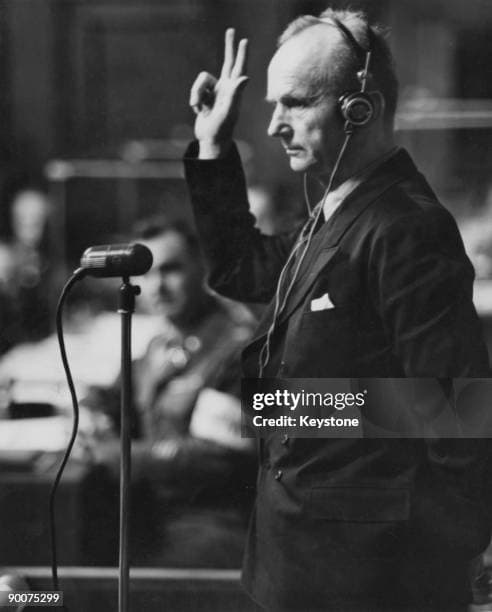
Karl Dönitz during the Nuremberg Trials
Nuremberg Trial and Postwar Years
After Germany’s defeat, Dönitz was arrested and tried as a major war criminal at the Nuremberg trials. He faced charges of crimes against peace and war crimes (notably for unrestricted submarine warfare and the Laconia Order). He admitted he was a dedicated Nazi and Hitler loyalist, but he defended his actions as military duty. In the end, the tribunal acquitted him of crimes against humanity but found him guilty of waging aggressive war and violating the laws of war. He was sentenced to ten years imprisonment. Dönitz served his term largely at Spandau Prison. Even behind bars he remained defiant; he famously told his judges he had “a clear, clean conscience.” Released in 1956, he lived quietly in a small town near Hamburg. He published his memoirs Zehn Jahre und zwanzig Tage (Ten Years and Twenty Days) in 1958 and spent the rest of his life defending the reputation of the U-boat crews. Dönitz died on December 24, 1980 at age 89. Throughout his life and afterward, Dönitz’s legacy has been fiercely debated. Many naval historians credit him as one of World War II’s great strategists whose U-boats came terrifyingly close to isolating Britain. Others emphasize that his absolute loyalty to Hitler and harsh orders (like the rescue ban) implicate him in Nazi atrocities. What is not in doubt is that as Grand Admiral and briefly head of state, Dönitz was among Germany’s most powerful and controversial military leaders – a man of remarkable skill and conviction who nonetheless stood by a criminal regime.